Those graphs are repetitive, but aperiodic (no translation symmetry). In Figure 15.1, “Penrose Quasicrystal in Progress” you can see (an intermediate state of the 3D layouting of) how a decagon has developed under four inflation/deflation iterations (see for example [Baa02a] and the section called “Pentagonal Quasicrystals” for more pictures). Other construction rules are imaginable. We don't rely on any fixed angles in first place of course.
Figure 15.1. Penrose Quasicrystal in Progress
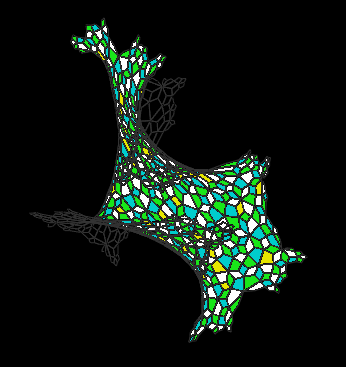
a Penrose quasicrystal (after applying some inflation/deflation rule in 4.th. iteration) on its way to an optimised layout
Actually those graphs are intrinsically flat (the layouting will only need more and more time to really achieve this in the embedding then). You probably could say that whereas the Gaussian curvature is invariant under isometries, the mean curvature is not but depends on the nice embedding.
Besides look at the interesting boundary formation, is it self-similar? The number of boundary edges goes (10, 20, 50, 120, 290, …) (2*pre + prepre? Fibonacci numbers would be pre + prepre), the number of faces increases as (10, 30, 90, 260, 740, …), this integer sequence is obeying which rule?
Of course it would be interesting to find rules giving a non-flat graph (perhaps locally varying Gaussian curvatures and overall mean flatness or s.th.). Or one could glue some edges together (as in the section called “Quad Hex tesselation on a torus”) to make full use of 3D.
Exercise: Find graphs obeying the inflation/deflation rule (or other quasicrystal matching rules) and having no boundary (perhaps simply start with an initial graph without boundary?).